The joy of making music is that there’s no single way to do it right. There are plenty of ways to do it wrong, of course. Between the two, you find your sound.
Like a lot of Generation X producers and musicians, I grew up on heavy metal, hip-hop, and dance music. From the last vestiges of disco and album rock, through the once-futuristic sounds of electro and early house, to the aggression of thrash, industrial, and techno, the mission of our music was always clear:
Move.
One word. Imperative.
For some folks, one word is enough. For others, there is the internet. For a unique variety of individuals — some say freaks, I say musicians — words don’t come close to achieving the true power of communication, of connection. I can tell you to move all day. I can even show you how, although you probably dance better. But if you’re going to perform a task, it’s best to enjoy it. I have found that the best way to get anyone to move is music.

Pretty neat, huh? I call it the pit. A keen eye will observe, even in this blurry photo, that this is a home studio, assembled with time, care, and sweat. What began with a Casio, a tape recorder and a few piano lessons has culminated in a lifetime of experience with all manner of software, samplers, synths, drum machines and anything else that makes a sound. Every device you see here (and a few you don’t, including enough SM57s to mic Neil Peart’s drum kit) has been played, recorded, and tirelessly studied. It is, for me, the musical equivalent of what Orson Welles said when he first laid eyes on the RKO Pictures back lot: “This is the biggest electric train set a boy ever had!”
I’ll have more in-depth discussions of the gear in later posts, but in a nutshell, the bulk of these devices are connected via old-fashioned analog cables, with a few USB connections here and there. Everything runs into the mixer/recorder on the left, a TASCAM Model 12, which I use to record bands as well as my own gear. Each station is set up for a different variety of music production. If I want raw, experimental music, I go with the table at right, which has a few Behringer machines, an SP-404SX sampler, a suite of always-reliable Korg Volcas, and a few handheld instruments, such as Pocket Operators, an original Microgranny, and the mini kaoss pad 2 and kaossilator 2. For hip-hop and pop, down center there is an Arturia Drumbrute Impact, an Akai MPC One, an OG Novation Circuit, a Korg wavestate (the hardest, most brilliant synth I’ve ever worked with), and the classic Alesis SR-16 drum machine. For techno and other EDM genres, near the Model 12 is Roland’s line of Aira instruments, including the TR-8S drum machine, the TB-3 bass synth, the SYSTEM-1 synth, and the VT-4 voice transformer, all running through the MX-1 mixer and effects box. The computer runs Ableton Live, my digital audio workstation of choice for over twenty years. There is also a printer, but I haven’t recorded it yet.
Sometimes, however, you just want to hear some tunes. For most folks, a streaming service, radio station, or small record collection will suffice. There is an atypical variety of musical extremist, though, for whom traditional audio delivery systems won’t cut the sonic mustard. We call this weirdo the DJ.

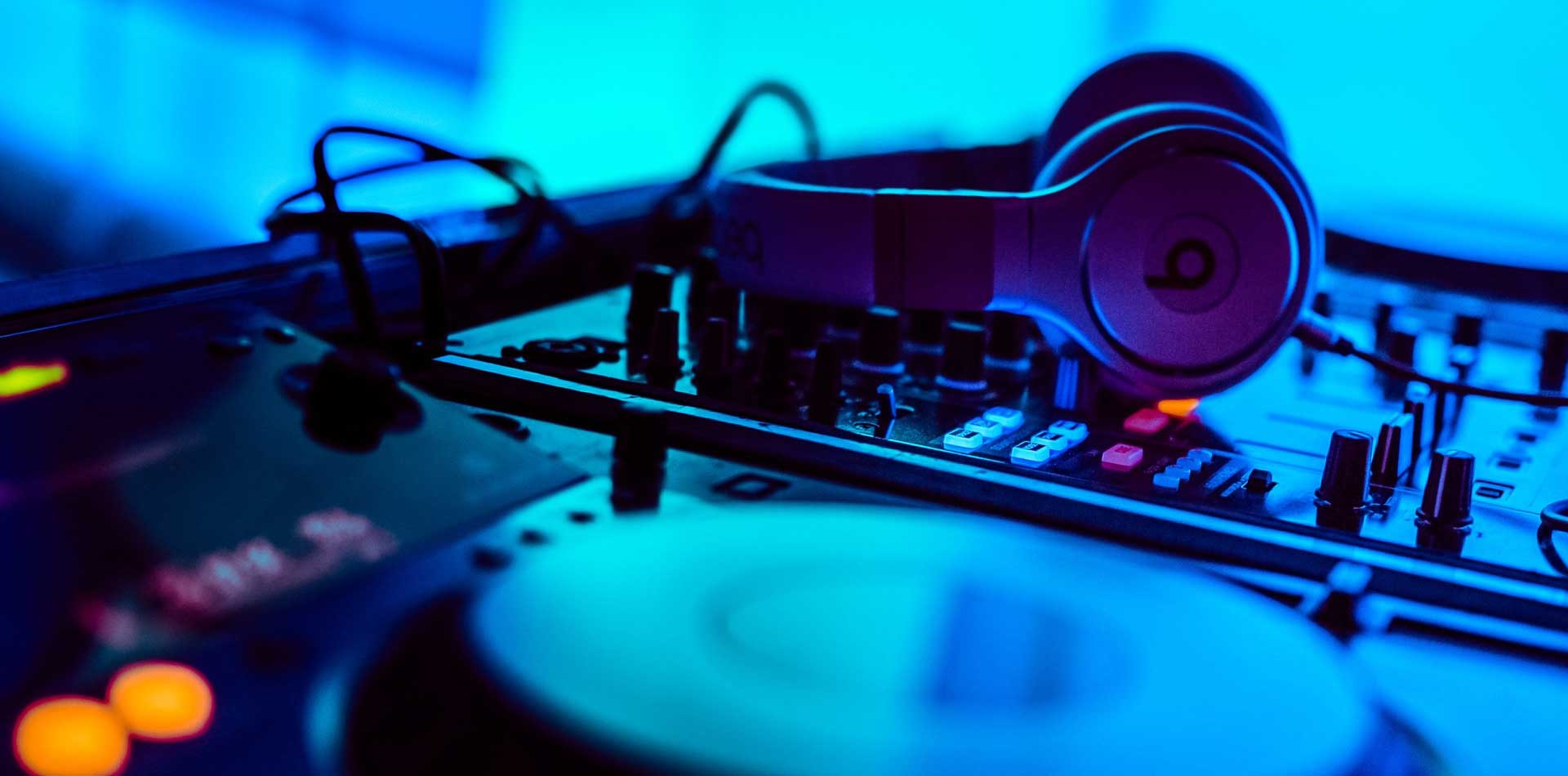
Please excuse the stack of books, the weight bench, and the slight lack of cable management, as this photo was taken the night my Traktor S3 arrived. I got a few lights, too, which is why everything is blue.
In the early days of laptop DJing, before I even had a laptop, my late friend Kurt Otto, aka Popeye-X, turned me on to Traktor, Native Instruments’ fascinating little piece of DJ software. I’d done college radio with CD’s, records and tapes, but hadn’t played a party or event up to that point. Years later, when I was DJing live on Twitch and in local bars, I used Traktor almost exclusively. I had one of those all-in-one DJ decks on hand as well, but was dissatisfied with the lack of options. I liken it to folks who learn to drive on standard versus automatic transmissions: once you’ve learned the one, you’re hesitant to embrace the other. Given my druthers, I’d use a pair of CDJs or even vinyl, but that will have to come later. For now, this rig — and the twin beast speaker system that gives it life — is my primary means of partying hard.
There’s other gear, of course. I have a solid lighting system, including two Mini Par Bars and a pair of Wash FX 2s. I even have a projector and a Linux laptop with Project M, for rave visuals. Like the in-depth audio posts, lighting will be covered in depth at a later date.
Right now, though, the Enterprise is in drydock. This starship needs to move. The Scotty in me seeks to fine-tune every nook and cranny, while the Captain Kirk in me wants to see what’s out there. If you’re a musician, I want to hear from you. If you’re looking for a wedding, quinceañera or event DJ, I want to hear from you. If you need a quick voiceover or a complete audiobook, I’ve done both and I want to hear from you. All genres are welcome. Give me a call at 210-350-7111, or email me at southboundtracks@proton.me.
— Forrest