Every once in a while, I’ll see a post from a new producer, asking where to start their electronic music journey. Is there a specific DAW they should use? Where can they get drum sounds? Hardware or software? Is the $500 synth plugin they just bought sufficient, or should they auction a kidney for one with more presets?
These posts tend to get the worst responses, usually from the regular gaggle of internet stiffs who spend too much time online instead of in the studio. It’s an online gamer mentality, which is really just a high school sports mentality: “This guy is a noob, which I totally never was.” So well-meaning, intellectually curious questions get downvoted, or receive short, pithy, meaningless comments, or are simply ignored.

Such is the nature of our discourse. Online, everyone’s made up their mind. As an old-school netizen, I have no patience with such rabble.
As a musician, producer and educator, I have all the patience in the world with anyone willing to learn. Intellectual curiosity is its own reward, if you stay curious and respect intellect. If you prefer to sit in the back and yap about nothing, there’s always social media.
What follows are my current thoughts on making music, based on decades of experience. It is not a bible, or even a guide, but it should serve as one of many available examples. I’ll share some technical knowledge, but given the personal nature of music, and art in general, there will be a few autobiographical dips and dives. (Stephen King does that a lot.)
There are no shortcuts. If you get anything out of this post, let it be that philosophy.
***
I’m lucky to have grown up with a father who played guitar. A younger brother who followed, may he rest in peace. A grandmother who took me to piano lessons. Public schools with good music teachers. Storybooks with read-along records and tapes, where I heard beautiful John Williams scores behind exciting narration. The record my dad bought me with themes from E.T. and Raiders. The Fisher-Price tape recorder I used to obsessively document everything, from my voice, to movies on TV, to private conversations. The Casio PT-1 keyboard my mother bought me for Christmas. The Blizzard of Ozz and Women and Children First tapes I listened to all the time before I was five. My dad and his band, playing Skynyrd, ZZ Top and Blackfoot covers in the garage. Southside Music, where my dad took me along to check out the instruments, and where our friend Ron Jarzombek gave guitar lessons to my brother. A room of my own, where I could immerse myself in music, books, comics, cinema, toys, games, imagination. The radio stations that played metal, electro, freestyle, new wave, early house, and hip-hop, all of which found their way onto Memorex mixtapes. My karate classes, where I learned the discipline that kept me in shape, mentally and physically, for years. My high school journalism and theatre programs, where I learned the value of communication and presentation, and where I first learned to DJ for an audience. My college newspaper, radio station, and campus activities programs, which allowed me to speak my mind, play great music, start a film festival, put on a show. The video camera and VCR I used to shoot and edit my student films and, eventually, a public access show with my brother. The teaching career that allowed me to pay rent and buy gear.
Friends. Family.
I was lucky.
Not everyone is so lucky. I preface any semblance of advice with this in mind.
***
Learn all you can about music. It ain’t easy, but it’s worth it.
If you have kids, get them toy pianos and drums and learn songs together. If you teach or tutor, use music in your lessons. (When I taught English, I used to make worksheets about LL Cool J and Henry Rollins. I’m old.) If you live alone, crank up your favorite tunes, with respect for your neighbors, of course. If you can get your hands on a used guitar or keyboard, do it. If you have a laptop or phone, search for free music and audio apps, or get lite versions of Ableton Live or something similar. (Don’t pirate. Keep your computer clean.)
No matter how you access music, learn to listen. Repeat listening — to a single song, album, artist, or genre — is key. Think about the songs you listened to as a kid, on repeat, because they were so good. Think about the movies you’ve seen multiple times. Take your mind back to a time when everything was new. For me, it was those books, records, tapes. I’d hear the same piece of music multiple times, sometimes in the same day. After a while, I’d notice things I hadn’t the first few times: the singer’s voice breaking, the drummer dropping a stick, a bad guitar note, quickly glossed over.
We do the same thing with movies, comedy albums, anything that can be experienced multiple times. The kid who knows every line from a superhero movie, right down to a favorite actor’s intonation. (“Swear to meeeee…”) The cheerleader or karate student who goes through the motions of a routine until they know it by heart. The pool shark or salesperson who can spot an easy mark from a mile away.
As Wayne Gale says, “Repetition works, Davey.” If you can learn your favorite parts of a song by heart, you can learn another. If you can do that, you can, eventually, learn to play your own version.
We had a piano in the house. I wasn’t all that excited about the practice drills in the Schaum books my teacher assigned, but I was pretty good at learning the basic riffs to songs I liked. Without sheet music — which I still don’t use often but continue to learn, a bit at a time — I was able to create rudimentary versions of Metallica, Iron Maiden, Black Sabbath and Mötley Crüe songs. Having a VCR and a few hard rock VHS tapes from Flipside Records helped. I’d pop in the Crüe’s Decade of Decadence and figure out “Home Sweet Home.” I’d do weird, plodding versions of “Enter Sandman,” “War Pigs,” “Got the Time.” They sounded nothing like the albums, and they were a bit slower, but I could play for girls at school, which was nice.
By the way, there’s always a better musician than you, often in the same room. It is, after all, show business. So learn to play as well as you can. Practice every day. No app, overpriced course, or mind-numbing AI can take the place of practice. If you dispute this, watch Flavor Flav play the piano. That guy practices.
I fell out of practice for a few years. That can happen. It’s easy to lose interest. The brain wants change. I became a writer for a while, a whole other discipline. It happened mostly because it was easier to tote around a typewriter than a piano. (Told you I’m old.) I lost that tactile sensation of putting my fingers on the keys and making noise. I still listened to music and DJd at the student radio station, but a lot of this stuff wound up on the back burner while I worked on my communication degree.
I didn’t make music again until Animal let me borrow the four-track.
***
Atomic Mariachi Animal wants you to know that action figures are awesome. He’s right, of course. There are no better toys for growing minds than those that facilitate imagination. We were lucky enough to grow up when video games were less impressive and the internet didn’t exist. Contrary to what you see in retro synthwave horror movies, we weren’t constantly drenched in neon everywhere we went (except maybe the Poteet Strawberry Festival once a year). We didn’t have easy access to video and audio equipment, let alone DAWs and cheap hardware synths. We had a lot of imagination, though, especially with all the great broadcast and physical media around.
Some of us channeled it musically. I knew Animal in high school, where he played guitar in the mariachi band. He was then and remains now a damn good musician, and a wealth of information about damn good music. Through Animal, I got to hear Guns N’ Roses cover Alice Cooper’s “Under My Wheels,” with Alice on vocals, a track I’d only read about in Rock ‘n’ Roll Comics. He’s the biggest Michael Schenker, Ace Frehley and Lemmy fan you’ll ever meet, a true metal monolith.
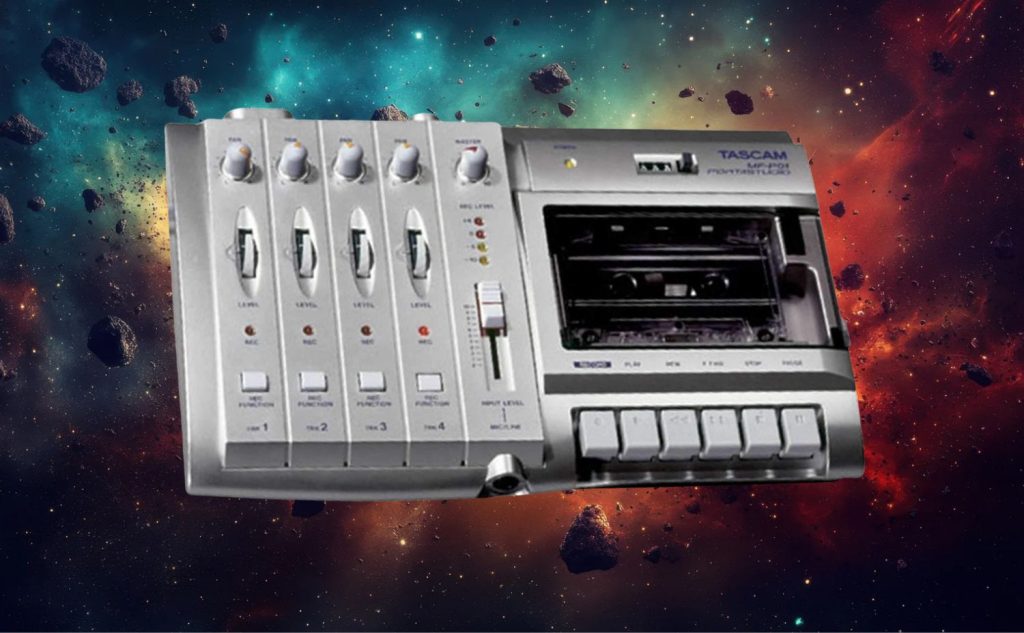
He also let me borrow my first four-track, a little TASCAM. My brother, Eric, had been using one with his bands, and I was fascinated by their functionality and ease of use. We were out of high school and in college, so this was during the CD and early DAW era, but tape was our native medium. I’d still use it if I could.
I’d made chop tapes as a kid, weird sound collages inspired by those old freestyle megamix tracks. Mine were heavily edited, and the results were, well, choppy. Rhythms would change from one piece to another: an Anthrax riff here, some N.W.A. there, Sam Kinison here, Weird Al there. I’d string anything I could together, usually to create long vocal passages, always with big laughs in mind. It was kind of like Buchanan & Goodman’s “The Flying Saucer,” but with no story, more stream-of-consciousness.
The four-track was a revelation to me. This was no Fisher-Price or Emerson shoebox recorder, but a real practice tool for real musicians. This was what James and Lars would record their Metallica demos on before going into the studio with Bob Rock. There was no manual, and my music keyboard was busted, but I was able to learn by doing, and wound up with a few songs made entirely a capella. I’d imitate drums in one track, bass in another, metal guitars in yet another, all of it my music. It was silly and, like the chop tapes, it got laughs. More importantly, it was all me, no samples.
***
I loved sampling. Sean “Puffy” Combs changed my mind.
Long before Puff Daddy was known as the subject of a Netflix documentary, he was known to old-school hip-hop fans as the guy who ruined hip-hop. Bad Boy Records had an undeniably talented roster of artists. Puffy was not one of them. While Public Enemy, Biz Markie, De La Soul and the Beastie Boys had broken new ground with sampling, Puffy turned out some of the lamest, most obvious hip-hop tunes of the decade. The good stuff went underground, but the mainstream was flooded with pop rap. A genre that had captured my imagination for years, the music I adored, had been cheapened with shiny suits and Sting covers.
So, for a while, I saw sampling as lame. I’m less elitist about it now, but thanks to songs like “Come With Me,” I don’t use other artists’ samples in my own work.
This approach forces you to rely on your own ideas. As much as I love the Zeppelin sample that opens the Beasties’ Licensed to Ill, and for all the guff I took for loving the Dust Brothers’ production on Tone Loc’s Lōc-ed After Dark, the prospect of anything I do appearing unoriginal is uncomfortable. Yes, I work in genres, and use the same scales and chords as everyone else. No, I’m not going to lift someone’s work wholesale and call it my own. Many dope producers have done it this way, but I’m not into it. I’d rather create something original that I can call my own. I know how to play, so I play. Anything less than my best effort is a waste of time. What’s more, even if you clear a sample, your song shares a copyright with the original artist, a deal that is often great for them, not so great for you.
This, by the way, is what really changed the sound of hip-hop in the 2000s. No one wanted to go to court and be called a thief, like when that judge told Biz, “Thou shalt not steal.” So we got the crunk era, with all those big synths that still fill dance floors. It was party rap, but it was better than Puffy. Dirty south forever.
***
I eventually gave back the four-track, but would occasionally catch wind of what was happening with digital recording at the time. I was working the desk at one of the dorms when a couple of students asked to use the computer lab. These guys were music nerds, and they had a bootleg CD of something called Pro Tools. I got curious and they let me play a few riffs on the computer keyboard. I figured out “Stairway to Heaven” and they told me to leave.
Some time later, I got my first computer, a Compaq from Office Depot. It unfortunately came with Windows Me, but it could also run CD-ROM video games. I had Driver, the precursor to Grand Theft Auto. I played a ton of Unreal Tournament. Most importantly, though, was the program that would change my life, found in a Target discount bin by accident and purchased for five bucks: MTV Music Generator.

I’d seen the Playstation version advertised, but had no idea you could get it for Windows. The price was certainly right. I didn’t have a car or a degree, but I had a DAW, not that I knew that word at the time. I started like most folks do the first time they play around with music software, creating songs out of pre-existing loops. Those were alright, but they weren’t my riffs or beats. What really made it useful was when I figured out how to use the mouse to input my own melodies and rhythms. It was a painstaking process, pretty much what a kid does with their first copy of FL Studio now, but the reward was clear: my own electronic music tracks. And this, from a guy who was mostly into metal.
Hearing electronic music was easy back then. It was like sonic wallpaper. I always liked it, having heard the Sleez Boyz, MCL and M/A/R/R/S at an early age. I’d dabbled in industrial and electronica, like KMFDM and the Chemical Brothers. I even liked Enigma! Learning to make electronic music, though, made me a true fan, and it did so instantly.
I finished college, dove deep into screenwriting, had a bad experience with an agent (if they charge up front, run screaming in the other direction), and began work on a teaching certificate. I moved back home, took some part-time work, and began to play around with Acid, back when it was a product of Sonic Foundry. It took a while to figure out the MIDI functions, but I was more interested in its sampling and time-stretching capabilities. Here was a program that allowed you to record directly from your PC, then chop, stretch, condense, anything, really. I didn’t have a manual, but that didn’t stop me from making a few remix tracks. Those tunes are long gone, but I got a big kick out of recording and remixing the themes from Friday the 13th Part III and The Legend of Zelda. I even made a Beastie Boys/John Carpenter mash-up, which was on my old YouTube page for a few years.
Then I met Kurt Otto.
***
My brother loved him. I did, too. My family ran with a lot of San Antonio musicians back then, so I was aware of Kurt through his Church of Machines album, which he’d given to my dad. He had a few synths and guitars, but was more interested in what computers had to offer. I had told him about my Acid tracks, and how I hadn’t really done much with it outside of remixes.
“Aaaaacid? Naw, mayun. Ya gotta mess with that Ableton, mayun. And that Reaktor. That’s all you need.”
He was right. He gave me a couple of programs and I got to work, making my own tracks again. Ableton Live 4, Reaktor and Traktor set me on a path I didn’t stray from for years. I eventually bought my own copies, but without Kurt’s generosity and kindness, I never would have known about them.
I spent years learning, experimenting. I was called for jury duty, and took my Ableton user guide with me. I spent a whole day just reading about what this software could do, yet another revelation. I didn’t get to serve on the jury, but I was okay with that.
I eventually figured out how to use VST plugins, including a lot of free ones that haven’t been available since Windows was 32 bit. I’ve replaced them with better stuff, but they were great to learn with. I scoured Wikipedia every night for anything I could find about different synths, as well as the history of electronic music. I got my hands on my first MIDI keyboard, and was blown away by the idea of playing any imaginable sound with a few free or cheap programs.
It still blows me away. Now you can get your tracks on streaming. We have Bandcamp, Soundcloud, Ampwall. Back then it was sites like ccMixter, or maybe you could get your stuff out on file-sharing networks. (I couldn’t, as we were on dial-up at home.) Even YouTube was just a bunch of home movies back then.
Now it’s too easy. Now you can type a prompt into a box and it spits out fake slop music that you didn’t make yourself. Then you can upload it wherever you want and call it art. It’s sad.
On the upside, though, there is the dawless movement.
***
You don’t need a roomful of gear to make music. You don’t need Volcas, Pocket Operators, MPCs, a modular synth that looks like a supercomputer from a Bond movie, or anything outside of basic consumer electronics.
Everything you can do with hardware, you can do with a laptop and a free copy of Reaper. Kurt swore by it, and used it exclusively in his later years.
You can also get Caustic, which used to cost only ten bucks in the Play Store, but is now available for free on Internet Archive. I haven’t messed with the Archive version, but it’s a bummer you can’t get it on Android without a workaround. I’d gladly buy a Windows version, and anything else from Single Cell Software. Maybe they’ll come back.
There is also Audacity, which does the same thing as Cool Edit, but for free. It’s a classic these days, but it still does the job. I recorded an entire audiobook in Audacity.
Before Silicon Valley decided that the internet was for sale, it was well-known as a hub for free software. The move from websites to apps has turned much of the internet into a giant paywall, but there are still good programmers who put their work out for free or for a small donation. CDM has been covering the “free as in beer” software movement for decades, and I highly recommend reading them if you’re on a budget. You’ll also learn a ton of info on how electronic music is made, and the culture at large. I’ve been a regular reader since the late 2000’s. CDM rules hard.
So don’t think that you have to shell out six months’ worth of paychecks for the latest DAW or plugin, or ruin the family computer with pirated garbage. There are free and inexpensive music apps for every operating system. Do your due diligence and find a few. The Android version of FL Studio costs $14.99. Times are hard, but you can get your hands on $14.99.
Linux is a gold mine of free stuff, by the way. If you have an old laptop lying around, and it won’t upgrade to the latest version of Windows, Ubuntu and other Linux distros are easy to install. All you need is a USB drive and the official instructions. From there, you can get some of the best free music software around. I’m a big fan of Bespoke Synth and Project M. Computing is for everyone, not just the rich.
If you have a Sweetwater account and a couple bucks, though, music hardware is more ubiquitous than ever, quietly gaining steam alongside advances in PC technology. Good producers understand that art thrives on limitations. While a DAW will give you every option under the sun, a couple of Volcas or a decent groovebox will usually do a few things very well. The trade-off is that you get a more tactile experience, with the added benefit of real circuitry doing the work rather than ones and zeroes simulating it.
If there’s any drawback besides the cost, it’s that hardware is usually manipulated live, even if you’re using preprogrammed patterns. A DAW track is more like a word processor file, in that you can go back and edit. You can do the same with hardware if you get a mixer/recorder like the Model 12, but that stuff can get expensive.
Over the summer, I used my Model 12 to record isolated drum and synth tracks from a few machines. I got great results from my Arturia Drumbrute Impact, my Roland TR-8S, and my Korg wavestate. I later dropped the individual tracks into Ableton, and they sound fantastic, especially with Ableton’s effects. I’ve also used my Akai MPC One with the Model 12, sending individual tracks out via USB and recording live. Again, great results, which can later be edited in the box.
If you’re really adventurous, though, and a lack of options doesn’t bother you, all you need is a few machines, a live mixer, and a simple, two-channel recording. Rehearse, mix and record live, do a simple master afterwards and you’re on to the next jam… ideally. Practice first. Better yet, hit record, start jamming, and figure it out as you go. Making music is the most fun when it’s done spontaneously.
***
There’s way more to this topic than even a post as long as this one can cover. Your bottom line should be to learn as much as you can and have tons of fun. Don’t worry about trends, brand loyalty, nerd comments or trying to blow up online. Don’t worry at all! We’re here to have a blast… and maybe even show off a little. More soon. Until then, good people, go get em.
Thank you for reading this! I’m a producer, DJ and audiobook narrator. If you’re in need of any of these services, call or text at 210-350-7111.
— Forrest